Elves
Life Ever-Ending
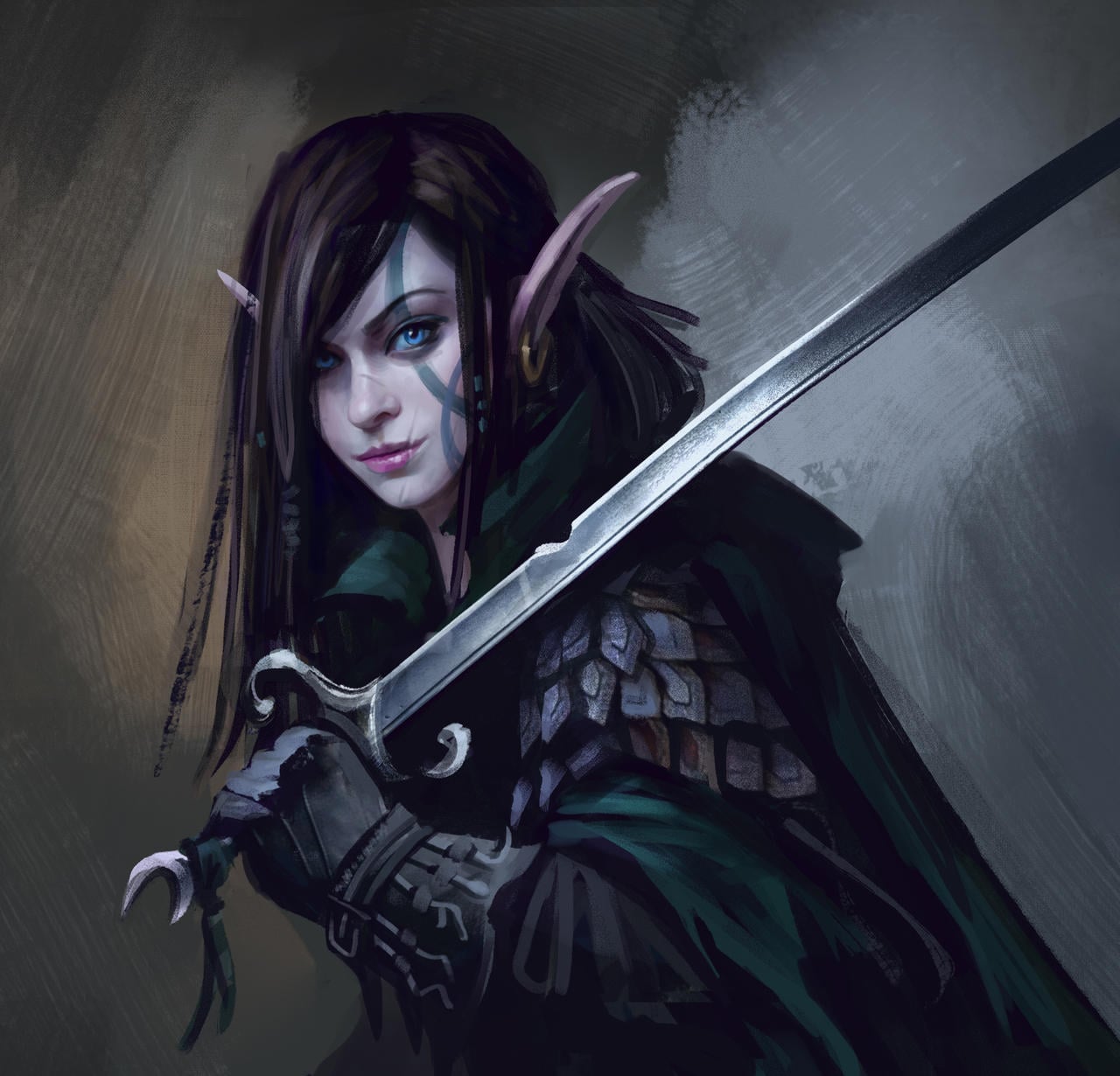
Ancient beyond telling, far predating any other mortal race, the elves were the first of those doomed to die, and the last race born touching the First World, where time is a thing walked through and the seasons were ruled by royalty. Known for their friendliness, admired for their beauty, elves never age past their physical prime; but their vaunted agelessness comes at a steep price — no elf lives far past their fiftieth birthday, and all are born knowing the day they will die.
Singular Elf
Denominative Elven
Endonym Esseness, Illyænna, Helciel, others
An elf knows without thinking what other mortals must learn. All elves are born knowing they will die, and knowing when. The count begins imprecise — a window of years, a vague sense of dwindling — but the clock sharpens with age, until in her final decade she can hear the seconds falling away, until a body that has never aged, never scarred, and never sickened simply stops. They will not see sixty. They will never look older than twenty. This is the price paid by the Ageless.
An elf sees what others cannot. Where others blunder blind through a world saturated with the unseen, an elf perceives the glow of divinity in all things, can taste the residue of spellwork, can sense the fae the way a cat senses a storm. An elf’s eyes can thread a needle by starlight and her ears turn like a rabbit’s, catching sounds not meant for the newer peoples of the world, and she is quick and light and graceful in a way that nothing made of flesh will ever be. She is brighter than most — faster, sharper, with a memory that never blurs. Elves are without exception female, and will only ever bear more elves, every daughter a near-copy of her mother.
An elf is not alone, even when she is alone. There is something in them that reaches out — toward other elves, toward anyone. They adapt fast, bond fast, fit in fast, because something in a deeper part of their soul needs to fit, needs to belong, needs to resonate with anything it can find. Most sister-elves — elves who live among other races, outside the great Families — are bright and eager and quick to make themselves welcome in whatever society gives them half a chance. This is not friendliness. A sister-elf is a soul built to harmonize with a thousand others, singing to itself in the dark because there is nothing else to sing to. She is her own mother, her own daughter, her own sister — a Family of one, a piece of something that was never meant to be taken apart.
Elves do not really die young. Elves do not really die at all, though there are enough corpses to fill the skies. Every elf alive is a near-copy of one of nine originals, dead since before time was an arrow, and yet those originals are not dead, because every elf that has ever lived is them. The great elven Families are not nations of cooperating individuals. They are each a single ancient creature wearing a million faces, an ur-elf dying and being reborn a hundred times a day, sustained across millennia by a transcendent bond called the Mildness. To those within, it is ecstasy, a belonging that transcends all mortal bonds; to those without, it is a terror beyond words.
But most elves are not one of those. They are sister-elves: splinters, strays, elves who grew up outside the song, or were torn from it, or never joined. And maybe that is a tragedy — a fragment of something vast, barely making do. Or maybe it is the only way to be a person rather than a limb. The pull is always there. Your mother felt it. Your daughters will feel it. Enough of you in one place and the singing starts whether you want it to or not, and every race that has ever lived alongside elves knows this and fears it. The question is not whether or not the Mildness is home: it is. The question is whether it is yours — and if not, if she who can find a home everywhere can be said to have any home at all.