Dwarves
The Makers Made
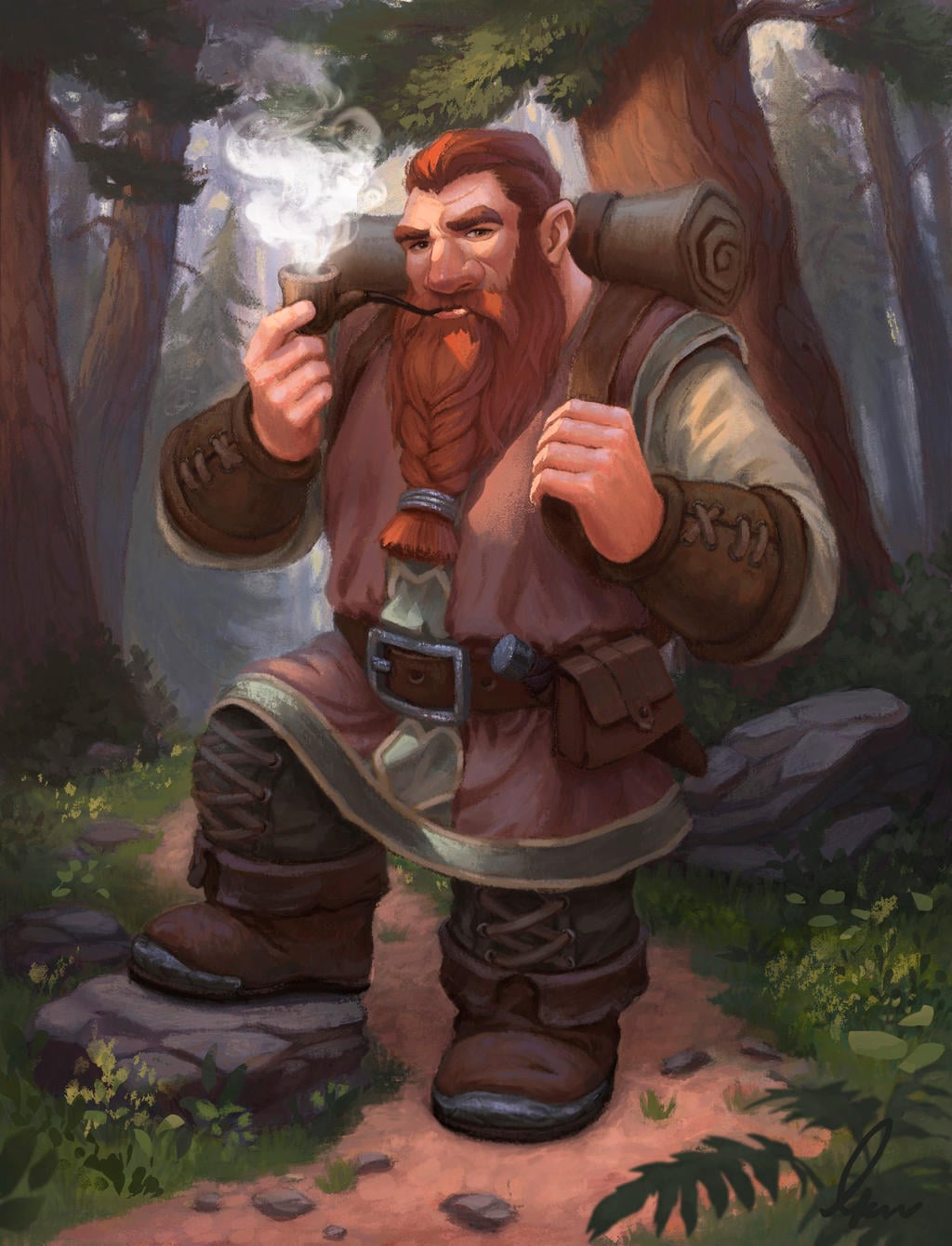
The dwarves are the lords of the Kingdom Below, but like all else they possess, it was not made by their hands. They are an ancient folk from the early days of the Second World, but they are not the originals, and were never meant to be their own creatures. For the Dawi, as they call themselves, are a mighty race created for purpose, moulded with intent. They were shaped by skill no dwarf has, and for reasons no dwarf knows: and their makers and their masters died long ago, leaving behind servants who still wear chains.
Singular Dwarf
Denominative Dwarven
Endonym Dawi (sg. Dawille)
A dwarf knows what he is doing before he knows why. His hands find the fault in the pottery before his eyes do. He picks up a tool he has never held and it sits right in his grip, and the work begins, and he does not remember deciding to start, or deciding what the work was at all. There is something in a dwarf that answers — not to a voice, exactly, but to the shape of a task that needs doing, the way iron answers to a lodestone. A dwarf is not driven in the way an ambitious warlord is driven or dedicated as the craftsmen of other races are dedicated. He is called — to work, to toil, to the smallest part of a greater purpose.
A dwarf near other dwarves is more than a dwarf alone. Working alongside their own kind, they feel the task more clearly, strike more truly, think more keenly, as though the voice of the unseen master is louder when brought together. This is not magic and not culture and not training: it is what they are made of, remembering what it was made to do. For a dwarf was made, by hands more skilled than any dwarf will ever have, from stone and clay and Earth Blood, to serve the Dwarren — living gods of carven bedrock who were themselves the handiwork of Toradin, the greatest maker of all. A dwarf maintains what their masters made. A dwarf keeps what their masters took. Even what a dwarf builds is not theirs, truly; for is the work of an instrument not the work of the hand which wields it?
But now the Dwarren are gone. Their Dvargstones faded, and their bodies stilled, and now they stand as statues in the halls they carved. No final orders were given, and no decree of emancipation. The foremen stopped, and one day the labourers looked up from their work and found that there was no one left to tell them what to do. The call has not stopped. But where once it was clear, a single voice saying make this, tend that, build here — now there are two, and they disagree.
From above, there is the ringing of the forge-fire, the hum of toil and creation, the will to take what is and shape it into more, to turn stone to statue and ore to steel and steel to shining things that were not there before: the cry of Toradin, which says that a dwarf was made to make. But from below, rising through the stone on which he stands, there is something else: the heartbeat of the earth, vast and slow and warm, the pulse of something much older and much larger than the god who shaped the dwarves. It says nothing. It is the sound of stone being stone, and a dwarf who hears it might be reminded that they, too, are stone. Every dwarf has heard it, in the silence between breaths, in the pause between heartbeats, in the moment before sleep when the hands and the mind stop.
And there is something dreadful about hearing two voices: for a worker who obeys two masters is a worker without a master. The dwarves were a race built for a purpose, and now that purpose is gone: and those who were made to be makers are given the chance, and are forced, to decide what it is they make — and why.